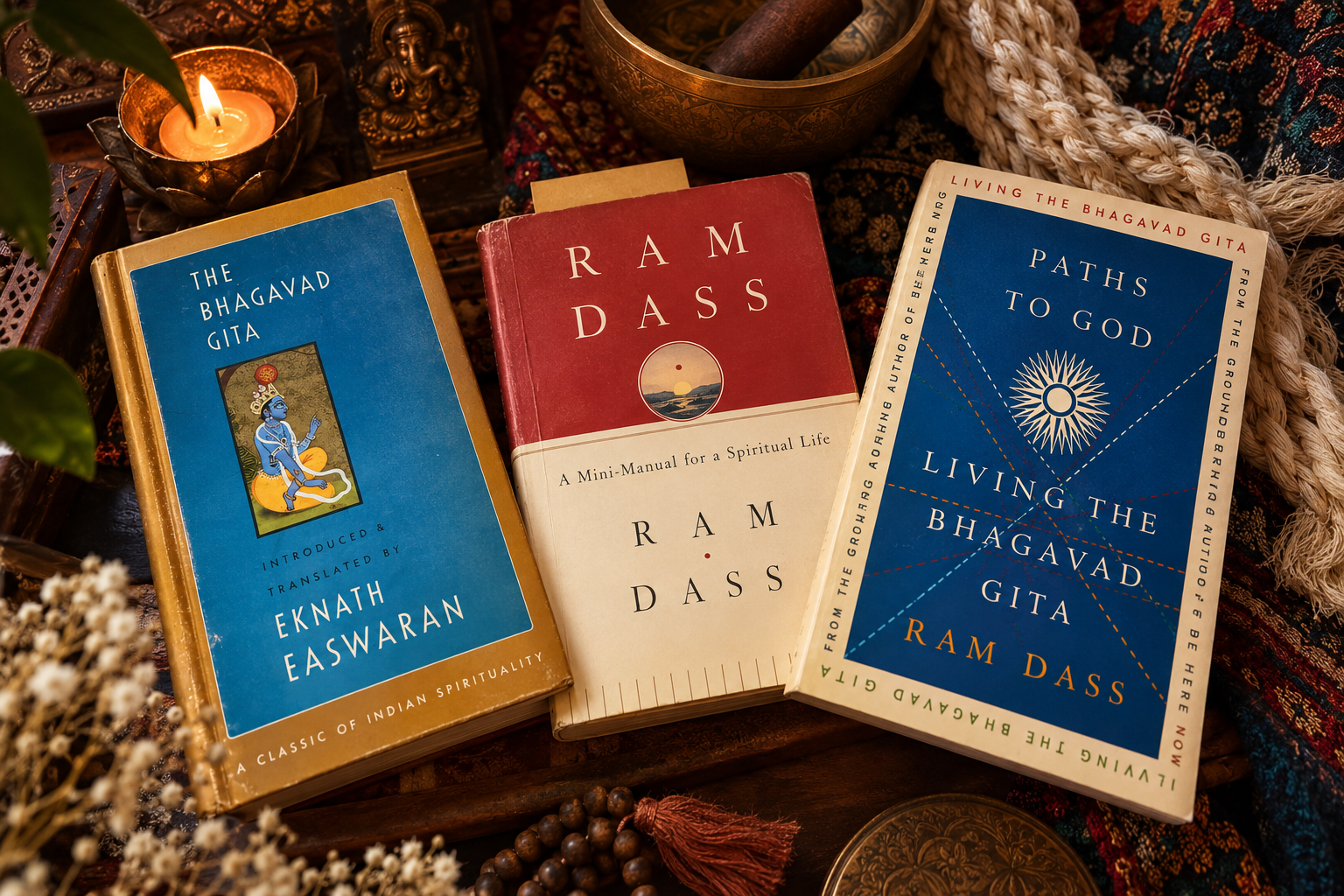
There are three books I keep close and return to almost every morning.
The Bhagavad Gita, translated by Eknath Easwaran. Ram Dass: A Mini-Manual for a Spiritual Life. And Paths to God: Living the Bhagavad Gita, also by Ram Dass.
They're not books I'm necessarily trying to finish. They're books I sit with.
Some mornings I read a chapter. Other mornings, just a page or a few lines. Sometimes I find myself reading the same passage again because something about it feels different than it did the last time.
I think that's one of the things I love most about studying yoga philosophy. The words might stay the same, but I'm not the same person every time I encounter them.
The Bhagavad Gita: An Ancient Conversation
The Bhagavad Gita is a conversation between Krishna and Arjuna, set on the edge of a battlefield. Arjuna is overwhelmed by the choices before him, and Krishna guides him through questions about duty, action, devotion, the nature of the Self, and what it means to live with wisdom.
What fascinates me is how human Arjuna's struggle feels.
Thousands of years separate us from this text, yet the questions remain familiar. How do I know what is right? How do I act without being consumed by the outcome? How do I live in this world without losing myself in it?
I read Eknath Easwaran's translation because I find it approachable without losing the depth of the teachings.
I don't pretend to understand everything I read. In fact, the more I study, the more I realize how much there is to explore.
But I keep coming back.
Ram Dass: The Voice I Can Still Hear
Here's something I love.
When I read books written by Ram Dass, I can actually hear him speaking in my head.
His voice. His pauses. That wonderful humor. The way he could talk about something incredibly profound and then laugh at the absurdity of being human.
I've listened to so many of his talks that reading his words feels less like studying and more like sitting down with an old friend.
There's something comforting about that.
Ram Dass never seemed interested in pretending that being spiritual meant having everything figured out. He talked about the ego, attachment, suffering, love, and the messy business of being human with such openness.
And he could laugh at himself.
I think that's part of why his teachings have stayed with me.
He reminds me that spiritual practice isn't about creating some polished, enlightened version of myself. It's about becoming more aware of what's already here. The beautiful parts, the uncomfortable parts, and everything in between.
Be here now.
Three little words. An entire lifetime of practice.
Paths to God: Bringing the Teachings Into Life
Paths to God: Living the Bhagavad Gita brings these two worlds together for me.
Ram Dass explores the teachings of the Gita through the lens of lived spiritual practice, drawing on devotion, meditation, self-inquiry, and service.
I love the way he makes ancient philosophy feel like something we can actually work with in everyday life.
Because that's where the real practice happens, isn't it?
Not just on the yoga mat. Not just during meditation or while chanting.
It's in our relationships. Our frustrations. Our responsibilities. The moments when our egos get loud and we forget everything we thought we understood.
And then we remember.
Or at least we try.
A Practice of Returning
These three books have become part of my morning rhythm.
They sit alongside my yoga practice, chanting, and the quiet moments I make for myself before the day takes over.
I don't approach them with a reading schedule or a goal of mastering their teachings.
I'm studying. I'm questioning. I'm finding connections between things I've read before and things I'm only beginning to understand.
Some mornings something clicks. Other mornings I'm left with more questions than answers.
I'm learning to appreciate both.
I spent years wanting to understand Indian philosophy but feeling overwhelmed by just how vast it is. Eventually, I stopped worrying so much about where I was supposed to begin and started following what genuinely called to me.
These books are part of that journey.
And maybe that's what a living practice really is.
Not collecting spiritual knowledge. Not trying to become someone else. But allowing what we learn to slowly change the way we see, love, question, and move through the world.
One morning. One page. One breath at a time.
And when I forget? I begin again.
Kelli Mack